The critical path method (CPM) finds the longest chain of dependent tasks in a project. That chain sets the earliest possible finish date, and any delay on it delays the whole project. You list the activities, their durations and dependencies, calculate early and late start dates with a forward and a backward pass, and mark every task with zero float as critical. This guide walks through a worked example with eight tasks, explains float, and shows what to do when the critical path is too long.
What is the critical path method?
CPM is a scheduling technique that models a project as a network of activities. Each activity has a duration and one or more predecessors. The critical path is the sequence of activities with the longest total duration from start to finish. Tasks on it have no slack: if one of them takes a day longer, the project ends a day later. Tasks off the critical path have float (also called slack), so they can move within limits without changing the finish date.
The method was developed in the late 1950s by Morgan R. Walker of DuPont and James E. Kelley of Remington Rand to plan plant maintenance and construction. Around the same time the US Navy created PERT for the Polaris missile programme. Both are still the basis of every Gantt chart with dependencies.
Which terms do you need before you start?
| Term | Meaning |
|---|---|
| ES (early start) | The earliest day a task can begin, once all predecessors are finished |
| EF (early finish) | ES + duration |
| LF (late finish) | The latest day a task can end without delaying the project |
| LS (late start) | LF − duration |
| Total float | LS − ES (or LF − EF): how far a task can slip before the project end moves |
| Free float | How far a task can slip before the next task has to move |
How do you find the critical path step by step?
- List the activities. Break the work into tasks you can estimate, usually from the work breakdown structure.
- Estimate durations in one unit, for example working days.
- Define dependencies. For each task, write which tasks must finish before it can start (finish-to-start is the most common type).
- Forward pass. Go from the first task to the last. ES of a task is the highest EF of its predecessors; EF = ES + duration. The EF of the last task is the project duration.
- Backward pass. Go from the last task back to the first. LF of a task is the lowest LS of its successors; LS = LF − duration.
- Calculate float for every task. Tasks with zero total float form the critical path.
What does a worked example look like?
Take a small building project with eight activities. Durations are in working days.
| Activity | Duration | Predecessors | ES | EF | LS | LF | Total float |
|---|---|---|---|---|---|---|---|
| A Site preparation | 3 | none | 0 | 3 | 0 | 3 | 0 |
| B Foundations | 5 | A | 3 | 8 | 3 | 8 | 0 |
| C Order windows (delivery) | 10 | A | 3 | 13 | 10 | 20 | 7 |
| D Walls | 7 | B | 8 | 15 | 8 | 15 | 0 |
| E Roof | 4 | D | 15 | 19 | 15 | 19 | 0 |
| F Install windows | 2 | C, D | 15 | 17 | 20 | 22 | 5 |
| G Electrical | 3 | E | 19 | 22 | 19 | 22 | 0 |
| H Finishing | 4 | F, G | 22 | 26 | 22 | 26 | 0 |
Forward pass: F can start only when both C (day 13) and D (day 15) are done, so its ES is 15. H waits for F (day 17) and G (day 22), so it starts on day 22 and the project ends on day 26.
Backward pass: H must finish by day 26, so it must start by day 22. That gives G and F a late finish of 22. D has two successors, E (LS 15) and F (LS 20); the lower value wins, so D must finish by day 15.
Result: the critical path is A → B → D → E → G → H, 3 + 5 + 7 + 4 + 3 + 4 = 26 days. C has 7 days of total float but only 2 days of free float: if the window delivery slips more than 2 days, F has to move, although the finish date is still safe until the slip reaches 7 days.
What is the difference between CPM and PERT?
| CPM | PERT | |
|---|---|---|
| Durations | One estimate per task | Three estimates: optimistic, most likely, pessimistic |
| Expected duration | The estimate itself | (O + 4M + P) / 6 |
| Best for | Repeatable work with known durations, such as construction | New work with uncertain durations, such as research |
| Main output | Critical path, float, time-cost trade-offs | Probability of finishing by a given date |
In practice many teams combine them: they use PERT-style three-point estimates for risky tasks and then run the CPM calculation. For a broader view of the method see the critical path method entry on Wikipedia.
How can you shorten the critical path?
- Crashing: add resources to a critical task, for example a second crew on the walls. It costs money, so start with the critical task that is cheapest to shorten per day.
- Fast-tracking: run tasks in parallel that were planned in sequence, such as starting electrical work on finished floors before the roof is complete. It saves time but adds rework risk.
- Change the logic: check whether every dependency is real. Teams often link tasks out of habit.
- Reduce scope on the critical path and move non-essential work after handover.
After every change, recalculate. Shortening one chain can make another chain critical: in our example, path A → C → F → H takes 19 days, so you can cut at most 7 days from the critical path before the window delivery becomes critical as well.
What mistakes should you avoid?
- Missing dependencies. A task without a successor looks like it has huge float. Every task except the last should lead somewhere.
- Ignoring near-critical paths. A chain with 1 or 2 days of float can become critical after one small delay. Watch the tasks with the lowest float, not only zero.
- Planning without resources. CPM assumes unlimited resources. If the same crew does B and C, they cannot run in parallel, and the real critical path is longer.
- Calculating once. The critical path changes as actual dates come in. Update the schedule weekly.
How do you work with the critical path in project software?
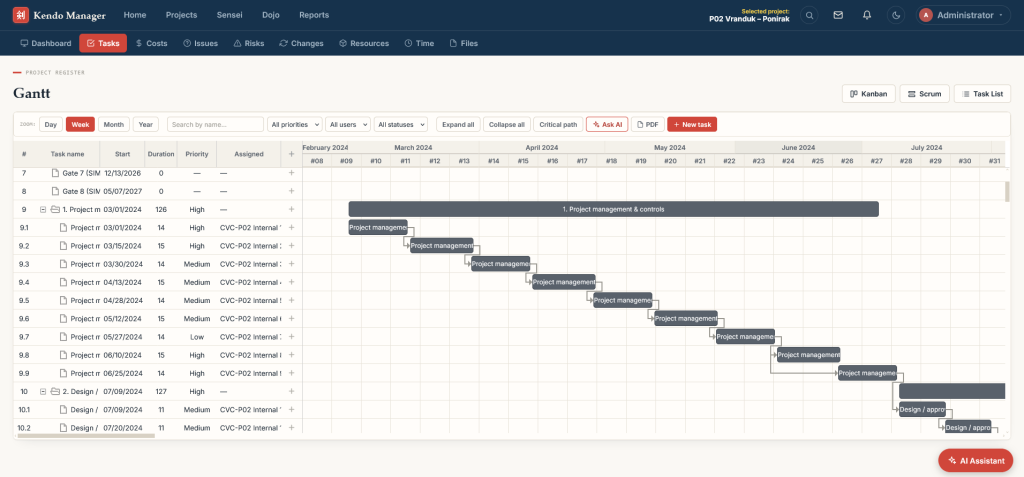
Calculating by hand works for eight tasks, not for eight hundred. A Gantt chart with dependencies keeps the network for you: you enter tasks, durations and links, and the chart shows how the chain of dependent tasks leads to the finish date. Our guide to Gantt chart software compares the options.
In Kendo Manager 5, our self-hosted project management software, the Gantt chart shows phases, tasks, dependencies and milestones on one timeline, next to the project budget, risks and issues. Because the critical path is mostly a construction and engineering tool, see also our guide to construction project management software. You can try the Gantt chart in the public demo at demo.kendomanager.com (user: demo, password: demo1234).
Frequently asked questions
Can a project have more than one critical path?
Yes. If two chains have the same longest duration, both are critical, and a delay on either one delays the project. That makes the schedule riskier, because there are more tasks without float.
Does the critical path change during a project?
Yes. When a non-critical task slips past its float, or a critical task finishes early, another chain can become the longest. Recalculate after every status update.
Is the critical path the same as the most important tasks?
No. It is defined only by time. An important task with a lot of float is not critical, while a simple task such as a material delivery can be.
Is CPM still used with agile methods?
Agile teams plan in short iterations and rarely draw a full network. CPM stays common in construction, engineering and other projects with fixed sequences; teams often use it for the overall plan and Kanban or Scrum for the daily work.
Need help setting up schedules and dependencies for your projects? Our project management services include setup and training.