
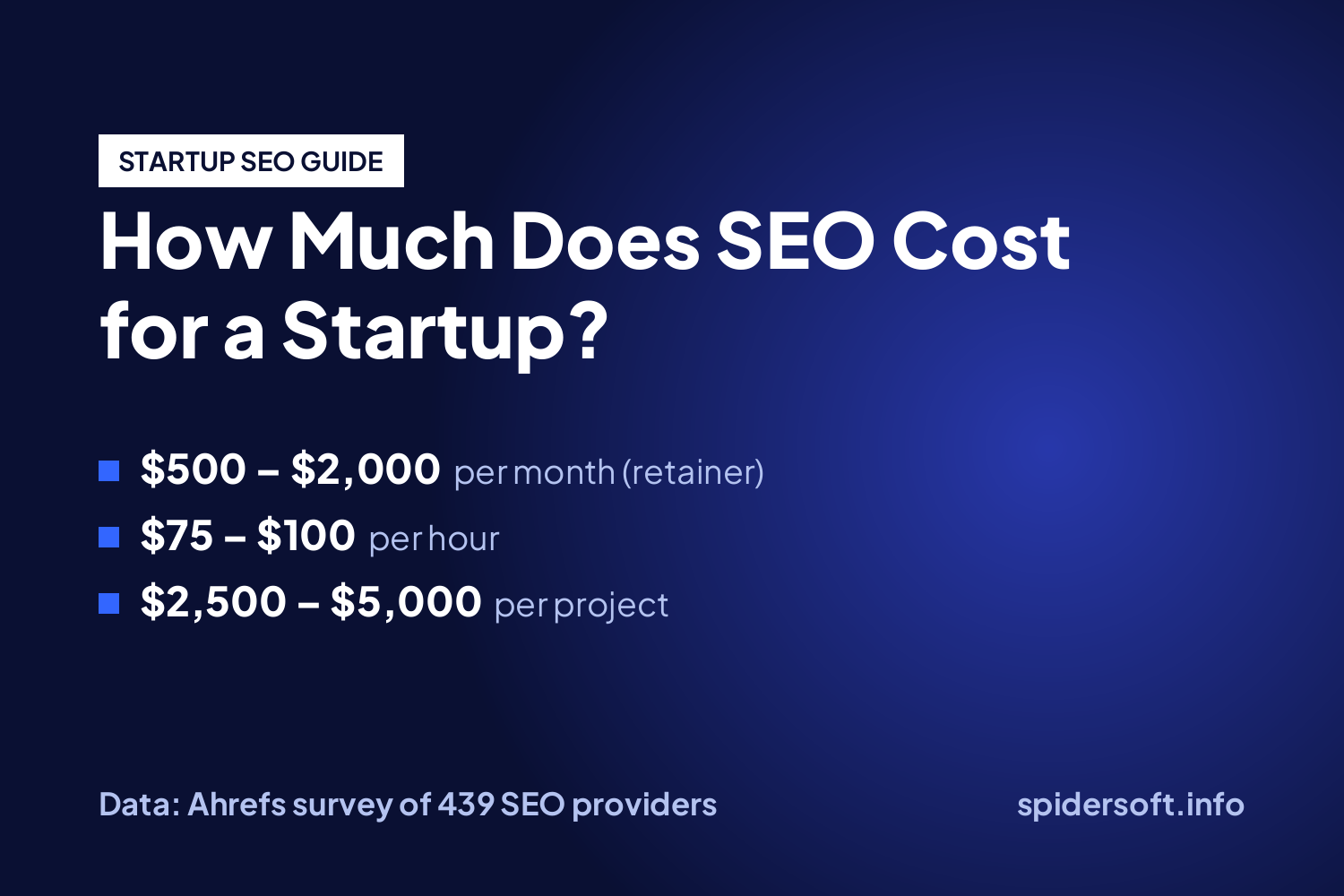
SEO for a startup usually costs $500 to $2,000 per month on a retainer, $75 to $100 per hour, or $2,500 to $5,000 for a one-off project. These are the most common price bands in Ahrefs’ survey of 439 SEO providers (updated August 2024). Where your startup lands in that range depends on six things: keyword competition, the technical state of your site, content volume, link building, target market, and the experience of the person doing the work.
How Much Does SEO Cost per Month for a Startup?
A monthly SEO retainer for a startup typically costs between $501 and $2,000. In the Ahrefs survey, 42.8% of providers charge in that band, 68.8% charge $2,000 per month or less, and the single most common band is $501 to $1,000 (20.4% of respondents).
| Monthly retainer | What the survey shows |
|---|---|
| $501 to $1,000 | Most common band, 20.4% of providers |
| $501 to $2,000 | 42.8% of providers |
| $2,000 or less | 68.8% of providers |
| $2,001 and more | 31.2% of providers |
Averages are higher than the most common band because 31.2% of providers charge more than $2,000 per month. Ahrefs puts the average retainer at $1,349 for freelancers, $3,209 for agencies, and $3,250 for consultancies. Note that Ahrefs calculated these averages from the top of each price band, so treat them as upper estimates.
What Are the Three SEO Pricing Models?
SEO providers charge in three ways: a monthly retainer, a fixed project fee, or an hourly rate. Most offer more than one, which is why the shares below add up to more than 100%.
| Model | Most common price | Providers using it | When it fits a startup |
|---|---|---|---|
| Monthly retainer | $501 to $1,000 per month | 78.2% | You need ongoing content, links, and monitoring after product-market fit |
| Project fee | $2,501 to $5,000 per project | 48.9% | Pre-launch setup, a technical audit, a site migration, or a keyword and content plan |
| Hourly | $75 to $100 per hour | 34.8% | Consulting calls, reviewing work your own team does, or one specific problem |
For an early-stage startup, a project fee is often the cheapest entry point. A one-off audit and content plan fixes the foundation, and a retainer can follow once the product and positioning stop changing every month.
What Can a Startup Expect at Each SEO Budget Level?
Each budget tier buys a different amount of work, and the biggest jump in results usually comes from moving from “fixes only” to regular content production.
| Monthly budget | Typical scope | Realistic for |
|---|---|---|
| Under $500 | Technical monitoring, on-page fixes, Google Search Console reporting. Little or no new content. | Keeping a small site healthy; local or very narrow niches |
| $500 to $1,500 | Keyword research, 2 to 4 optimized articles or landing pages per month, internal linking, basic outreach. | Seed-stage startups targeting long-tail keywords |
| $1,500 to $3,000 | Topic clusters, 4 to 8 pages per month, digital PR or link building, conversion tracking. | SaaS and tech startups competing in an established category |
| $3,000 and more | A dedicated team: strategist, writers, technical SEO, and link building across several markets or languages. | Funded startups where organic search is a main acquisition channel |
The scope at each level is an estimate based on typical agency packages, not survey data. Always ask a provider to list the exact deliverables behind a monthly price.
Which Factors Change the Price of SEO for a Startup?
Six factors decide where a startup lands in the price range. Two of them, market size and provider experience, have measurable effects in the Ahrefs data.
- Keyword competition. Ranking for “project management software” takes far more content and links than ranking for “self-hosted project management for construction teams”. Startups that start with long-tail keywords pay less per result.
- Technical state of the site. A new site built on a clean stack needs a few hours of setup. A site with duplicate pages, slow templates, or a broken migration can need a separate project before any content work pays off.
- Content volume. Content is usually the largest line in an SEO budget. Each in-depth article takes research, writing, editing, and visuals.
- Link building. Earning links through digital PR, partnerships, and guest content is slow and expensive. Buying links is cheaper but breaks Google’s spam policies and can cost you your rankings.
- Target market. Providers serving clients worldwide average $3,474 per month, against $1,557 for providers who only do local SEO.
- Provider experience. The average retainer more than doubles with experience, as the chart below shows.
If your budget is tight, the technical factor is the easiest to control. Our website SEO checklist for startups covers the fixes you can do before paying anyone.
How Long Does SEO Take to Pay Off for a Startup?
Expect SEO to take a year or more before it becomes a reliable channel. In Ahrefs’ 2025 study of 1 million random URLs, only 1.74% reached Google’s top 10 within one year. When the sample was limited to non-empty English content, the share rose to 6.11%.
The same study found that 72.9% of pages in the top 10 are more than three years old, and only 13.7% are younger than one year. For a startup, this means two things:
- Budget SEO as a 12 to 24 month investment, not a launch campaign.
- Publish early. A page written in your first year has time to gain links and trust while the product grows.
Paid search and outbound sales can bring customers in the meantime. SEO lowers the cost of each customer later, once pages start ranking.
How Do You Calculate Whether SEO Is Worth the Cost?
Compare the monthly SEO cost with the recurring revenue that organic traffic adds. For a SaaS startup, the calculation fits in four lines:
| Step | Example value |
|---|---|
| Organic visits per month (after 12 months) | 3,000 |
| Visit to trial conversion | 2% = 60 trials |
| Trial to paid conversion | 20% = 12 new customers |
| New MRR per month at $49 per customer | $588 |
With a $1,500 retainer, those 12 customers do not cover the cost in the month they sign up. They keep paying, though. Each monthly cohort adds $588 to MRR, so after three cohorts organic search contributes $1,764 in recurring revenue per month before churn, more than the retainer. The example numbers are illustrative; replace them with your own traffic and conversion data. Our guide on what MRR is and how to track it explains the inputs.
Should a Startup Hire a Freelancer, an Agency, or Do SEO In-House?
A freelancer is the cheapest option, an agency covers more skills at once, and in-house SEO makes sense once organic search drives a large share of revenue.
| Option | Typical cost | Strengths | Watch out for |
|---|---|---|---|
| Freelancer | About $1,349 per month on average | Low cost, direct contact, flexible | One person rarely covers technical SEO, content, and links equally well |
| Agency | About $3,209 per month on average | Several specialists, processes, reporting | Junior staff on small accounts; long contracts |
| In-house | A full salary plus tools | Deep product knowledge, fast execution | Expensive before organic search is a proven channel |
Many startups take a middle path: a project with an agency for strategy and technical setup, followed by in-house content written to the agency’s plan. To compare this model with your options, see what our SEO agency for startups includes, or our SaaS SEO services for companies with recurring revenue goals.
How Can a Startup Lower SEO Costs Without Hurting Results?
The cheapest SEO is the work you do not have to redo. These five steps cut cost without cutting quality:
- Fix the technical base once. A one-off audit costs less than paying a retainer to work around a slow or messy site.
- Target long-tail keywords first. Specific queries with lower volume convert better and need fewer links. Our guide to SEO for tech startups on a small budget shows how to find them.
- Build topic clusters instead of single articles. Ten connected pages on one subject build topical authority, which ten unrelated posts do not.
- Let founders supply the expertise. A 30-minute interview with a founder gives a writer the first-hand detail that generic content lacks.
- Refuse cheap link packages. Bulk link packages break Google’s spam policies, and recovering from the ranking loss costs more than the package saved.
FAQ: SEO Cost for Startups
How much does SEO cost for a small business?
A small business retainer usually costs $500 to $2,000 per month; 42.8% of providers in the Ahrefs survey charge in that range. Local-only SEO averages $1,557 per month. See our small business SEO services for what that budget covers.
Can a startup do SEO by itself?
Yes, for the basics. Founders can handle keyword research, on-page optimization, and Google Search Console with free tools. Technical problems, link building, and scaling content are where outside help saves the most time.
Is a $300 per month SEO package worth it?
Only for maintenance on a small site. At $75 to $100 per hour, $300 buys three to four hours of work per month, which is not enough to research, write, and promote even one in-depth article.
Should a startup pay for SEO before launch?
A one-off project before launch is worth it: a clean site structure, keyword research, and the first landing pages. Since only a small share of pages rank within their first year, pages published at launch get a head start.