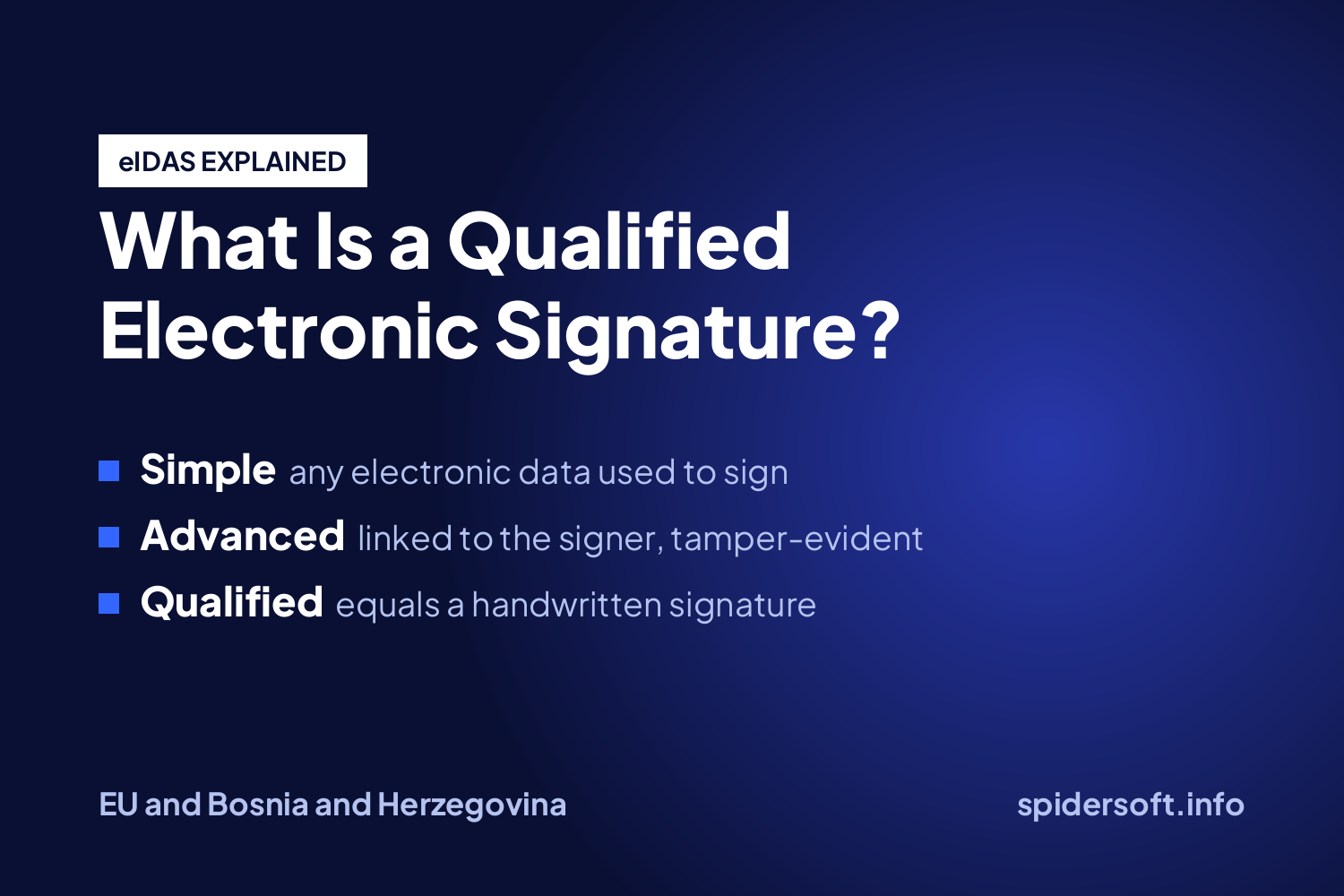
A qualified electronic signature (QES) is the highest level of electronic signature under the EU eIDAS Regulation: an advanced electronic signature created with a qualified signature creation device and based on a qualified certificate. In the European Union it has the same legal effect as a handwritten signature (eIDAS, Article 25(2)), and a QES based on a qualified certificate from one Member State is recognised as a QES in all other Member States (Article 25(3)). Bosnia and Herzegovina is not in the EU, but its laws give a comparable status to a secure electronic signature, as explained below.
What Is the Difference Between Simple, Advanced and Qualified Electronic Signatures?
Each level adds requirements to the one below it, and only the top level is legally equivalent to a handwritten signature.
| Level | What eIDAS requires | Typical example | Legal effect |
|---|---|---|---|
| Simple electronic signature | Data in electronic form attached to other data and used by the signatory to sign (Art. 3(10)) | A typed name, a scanned signature image, an “I agree” checkbox | Cannot be denied legal effect only because it is electronic (Art. 25(1)) |
| Advanced electronic signature (AdES) | Uniquely linked to the signatory, capable of identifying them, created with data under their sole control, and linked to the data so that any later change is detectable (Art. 26) | A certificate-based signature in a PDF, created with a key only the signer controls | Admissible as evidence; its weight is assessed case by case |
| Qualified electronic signature (QES) | An advanced signature created with a qualified signature creation device and based on a qualified certificate (Art. 3(12)) | Signing with a qualified certificate on a smart card, a USB token, or a remote signing service of a qualified provider | Equivalent to a handwritten signature (Art. 25(2)) |
What Makes an Electronic Signature “Qualified”?
A signature is qualified when three building blocks come together: the advanced signature requirements, a qualified certificate, and a qualified signature creation device.
- Advanced signature requirements. The four conditions of Article 26: the signature is uniquely linked to the signer, identifies the signer, is created with data the signer controls alone, and reveals any change made to the document after signing.
- A qualified certificate. An electronic certificate that meets Annex I of eIDAS and is issued by a qualified trust service provider (QTSP), a provider that a national supervisory body has granted qualified status (Art. 3(20)). Before issuing it, the provider must verify the identity of the person (Art. 24).
- A qualified signature creation device (QSCD). Hardware or software that meets the security requirements of Annex II and protects the signer’s private key (Art. 3(23)).
The device does not have to be in the signer’s hands. eIDAS allows remote signing, where a qualified provider manages the signature creation device on the signer’s behalf, as long as the signer keeps sole control over the signature creation data (recitals 51 and 52). On the EU trusted lists this is a separate qualified service: remote management of a qualified signature creation device. As of November 2026, the eIDAS Dashboard lists 249 active qualified trust service providers in 29 countries.
How Do You Get a Qualified Electronic Signature?
You get a qualified electronic signature from a qualified trust service provider, in four steps:
- Choose a provider. In the EU, pick a QTSP from the official trusted lists. In Bosnia and Herzegovina, pick a certifier registered under the state Law on Electronic Signature.
- Verify your identity. The provider checks your identity before it issues the certificate. Under the amended Article 24, it can use the European Digital Identity Wallet or an eID means at assurance level high, an existing qualified certificate, another method with a high level of confidence confirmed by a conformity assessment body, or your physical presence.
- Receive the certificate and device. The qualified certificate is stored on a smart card or USB token, or in a remote signing account managed by the provider.
- Sign documents. Use the provider’s signing application or a PDF reader that supports certificate-based signatures, and confirm each signature with your PIN.
A qualified signature cannot be self-made. A self-made certificate can produce an electronic or even an advanced signature, but only a qualified certificate from a qualified provider, used on a qualified device, produces a QES.
How Can You Check Whether a Signature Is Qualified?
Check two things: that the signing certificate is a qualified certificate, and that its issuer is a qualified provider on a trusted list. Qualified signatures are embedded in standard formats defined by ETSI: PAdES for PDF (EN 319 142), XAdES for XML (EN 319 132), CAdES for other files (EN 319 122), and ASiC containers (EN 319 162), so any compliant tool can read them.
- Open the signature details. In a PDF reader, open the signature panel and view the certificate of the signer.
- Look up the issuer. Search for the provider in the EU/EEA Trusted List Browser on the eIDAS Dashboard, which shows every qualified provider and service by country.
- Run a validation report. Upload the signed file to the European Commission’s DSS demonstration web app, which reports whether the signature is qualified. The Commission offers it for testing, not as a production service.
The certificate’s status matters too. A qualified certificate that is revoked after activation loses its validity from the moment of revocation (Art. 28(4)), so a signature is valid only if it was created before that moment.
Where Is a Qualified Electronic Signature Used?
A QES is used wherever the law requires a handwritten signature or written form, or where the parties want the strongest proof of who signed. Common cases:
- Public procurement bids and filings to public authorities
- Company register filings and corporate decisions
- Employment contracts and other documents that require written form
- Property transactions: in England and Wales, for example, HM Land Registry accepts qualified electronic signatures for transfers and charges (HM Land Registry, 2025)
- Public administration, including the certification of signatures, manuscripts and copies in municipal citizen service centres
The last example is what our ESIO e-signature software does in 22 municipalities and cities in Bosnia and Herzegovina: the citizen signs on an LCD signature pad, and the municipal officer confirms each certification with a qualified electronic signature.
What Changes with eIDAS 2.0?
eIDAS 2.0 (Regulation (EU) 2024/1183), in force since 20 May 2024, adds the European Digital Identity Wallet. Every Member State must offer at least one wallet, and the European Commission expects citizens to receive them in 2026. Each wallet must let natural persons create qualified electronic signatures by default and free of charge, although Member States may limit the free use to non-professional purposes (Art. 5a(5)(g)). The regulation also updates how providers verify identity before issuing a qualified certificate, as described in the steps above.
How Does a Qualified Electronic Signature Work in Bosnia and Herzegovina?
Bosnia and Herzegovina is not an EU member, so eIDAS does not apply directly, and a qualified certificate from a Bosnian certifier is not automatically recognised in the EU. Inside the country, the legal framework is:
| Level | Law | Key point |
|---|---|---|
| State | Law on Electronic Signature (Zakon o elektronskom potpisu), Official Gazette of BiH 91/06 | A secure electronic signature satisfies the legal requirement for a handwritten signature and written form (Art. 5). Certifiers are supervised and accredited by an office within the ministry responsible for the information society (Art. 20). |
| Republika Srpska | New law on electronic identification, trust services and electronic documents (2026) | Aimed at alignment with eIDAS 2.0, including trust services and a digital identity wallet (Paragraf, November 2026) |
| Federation of BiH | Law on Electronic Document (Zakon o elektronskom dokumentu), Official Gazette of FBiH 55/13 | Regulates electronic documents and electronic signatures in federal and cantonal bodies |
A new state law on electronic identification and trust services, aligned with eIDAS, was in preparation in 2026. Until it is adopted, the 2006 law remains the basis for electronic signatures at state level.
FAQ: Qualified Electronic Signature
Does a typed name count as a signature?
Yes, as a simple electronic signature. Under eIDAS it cannot be rejected only because it is electronic, but it has no presumption of being equivalent to a handwritten signature. If the signature is disputed, its value as evidence depends on how well it can be linked to the person who signed.
Is a digital signature the same as a qualified electronic signature?
Not always. “Digital signature” describes the cryptographic technology. A digital signature becomes a qualified electronic signature only when it is based on a qualified certificate and created with a qualified signature creation device.
Can I make a qualified electronic signature myself?
No. You need a qualified certificate issued by a qualified trust service provider after an identity check, and a qualified signature creation device.
Is a qualified signature from Bosnia and Herzegovina valid in the EU?
Not automatically. eIDAS recognises trust services from countries outside the EU as equivalent only on the basis of an agreement between the EU and that country (Art. 14).
Related reading: ESIO e-signature software for local governments · E-government services · E-signature projects in Bosnia and Herzegovina